



How to improve your VO2 max: the short version
VO2 max is the maximum amount of oxygen your body can use during hard exercise. It is one of the strongest predictors of healthspan, and it responds to training at any age. If you only read one section, make it this one:
- Build an aerobic base first. Two to four sessions a week of easy, conversational-pace endurance work (often called zone 2) grow the mitochondria and capillaries that set your ceiling.
- Add one or two hard interval sessions a week. Intervals of 3 to 5 minutes at an effort you can barely sustain, with equal recovery, repeated 4 to 6 times, are the best-documented way to raise VO2 max. Shorter sprint intervals work too once you have a base.
- Train the muscles that move you. Strength training, especially for the legs, improves economy, so the oxygen you can take in goes further.
- Recover and fuel. Sleep, adequate protein and iron status all limit adaptation; check ferritin if progress stalls.
- Measure it. A lab test is the gold standard; a watch estimate or a field test such as a 12-minute run tracks trends well enough. Expect meaningful gains within 6 to 8 weeks, and the biggest jumps if you start from a low base.
The rest of this article is the full scientific review: what endurance is physiologically, how VO2 max is measured, why it matters for longevity and how to structure training for it.
Endurance refers to the body's ability to withstand fatigue and remain active whilst under physical strain. Endurance depends largely on the performance of the respiratory and circulatory system as well as the energy management in the muscles, i.e. their ability to convert fat and carbohydrates into energy.(1) This is determined by the number of mitochondria, the number of capillaries in the muscles as well as various metabolic pathways (glycolysis, Krebs cycle and oxidative phosphorylation). Maximal endurance refers to the level of intensity that ranges from the anaerobic threshold to the maximal aerobic exertion. It is determined by the maximal oxygen uptake (VO2max), the biomechanical power of the activity and the performance of the neuromuscular system.
Introduction
Endurance exercise is generally recommended as the basis of all healthy physical exercise. The recommendation is to exercise for at least 2 hours and 30 minutes per week (the common suggestion is five times per week, for at least 30 minutes each time).
Some activities considered to fall under endurance exercise include walking, cycling, swimming, hiking and even heavier house and yard work. The intensity varies depending on the individual's fitness level. To make significant developments in one's endurance fitness, it is usually necessary to include activities more arduous than walking, for example running, cross-country skiing, fast-paced cycling or various ball games. In terms of group exercise, various aerobics, dance, and cross-training classes are popular.
Endurance exercise can be divided into four types by the level of exertion involved: basic aerobic endurance, tempo endurance, maximal endurance and speed endurance. Endurance can also be divided into either aerobic or anaerobic exercise. In practice, basic aerobic endurance is the basis of all movement.
The boundary between basic endurance and tempo endurance is called the aerobic threshold. Similarly, the boundary between tempo endurance and maximal endurance is called the anaerobic threshold. Anaerobic (oxygen-free) energy production increases with the level of physical effort. The aerobic threshold is the level of effort at which anaerobic energy pathways start to be a significant part of energy production (usually under 70 % of the maximal heart rate).(2)
The anaerobic threshold is defined as the level of exercise intensity at which lactic acid builds up in the body faster than it can be cleared away by the heart, liver and striated muscles. For this reason, it is also sometimes called the lactate threshold (approximately 85–90 % of the maximal heart rate). Once the threshold has been surpassed, more lactic acid is produced in the muscles than can be removed, slowly leading to fatigue.(3) Both aerobic and anaerobic threshold may be increased by training. For example, runners want to increase their aerobic threshold because this will enable them to run faster for longer.

The indicative threshold values can be determined using the Karvonen formula:
(Maximal heart rate – resting heart rate) x desired heart rate zone between 60–90 % + resting heart rate
For example (189 – 50) x 0.7 + 50 = 147 (the estimated aerobic threshold for a 35-year-old individual with a resting heart rate of 50 bpm).
The most accurate method of estimating the maximal heart rate (HRmax) is to use the following formula:(4)
211 – 0.64 x age in years (for example 211 – 0.64 x 35 = 189)
A 2022 study saw the lowest mortality risk at a VO2 max of 49 ml/kg/min with no increase in risk with high cardiorespiratory fitness.(5) The least fit individuals had a 4x higher mortality risk than the extremely fit ones. Smoking typically increases mortality risk by 2-3x – smoking combined with obesity does so by 3.5-5x. This means that having low cardiorespiratory fitness and low VO2 max is one of the most significant lifestyle risk factors for increased mortality and shorter lifespan. It is almost as important as not smoking, if not even more important.
The Benefits of Endurance Exercise
Endurance exercise has both functional and structural benefits. Structural changes include increases in heart volume and muscular strength, lung volume, number of mitochondria and microvasculature. Functional changes include lower blood pressure at rest, lower resting heart rate, increased heart stroke volume and cardiac output, and improved oxygen uptake.(6)
Endurance exercise is known to have a positive impact on anxiety and depression, balancing stress and the treatment and prevention of numerous chronic illnesses.
It is also known to reduce the risk of cardiovascular diseases. It appears that to achieve these benefits, just three months of moderate training (2–3 hours per week) is required, after which further benefits are limited even if there is an increase in the amount or intensity of training.(7) Moderate exercise (MET <6) seems to be the best predictor of longevity and general good health.(8)
The Basic Principles of Endurance Training
Endurance training refers to exercise that improves the body's ability to sustain activity for a few minutes to several hours. Typical sports include walking, running, cycling, cross-country skiing, swimming and hiking.
Developing endurance usually requires training at least 3 times per week, for 30 to 60 minutes per session. Heart rate zones and a heart rate monitor can be useful. However, they are not strictly necessary. They mainly help you recognize different zones and their physiological impact on endurance training.
Key factors in endurance exercise:
- The majority of training takes place in the basic endurance zone, about 70-80% of the session. This develops basic endurance in general and cardiac output in particular.
- Focus on technique training.
- Training should be progressive, with enough time for recovery.
- High intensity interval training, HIIT, is particularly effective for increasing the number of mitochondria and maximal oxygen uptake, VO2max (9-10).
- Perform various interval exercises in the tempo and maximal endurance zones:
- Short intervals (HIIT): 15-45 second exercise intervals, rest for 15 seconds to 3 minutes.
- Long intervals: 3-8 minute exercise intervals, rest for 1 minute to 4 minutes.
- Incremental intervals: 8-20 minute exercise intervals, with varying rest intervals. The intensity is even lower than in long interval training.
- Strength training increases the effectiveness of endurance exercise and improves performance (11).
- Perform restorative exercises and avoid overtraining.
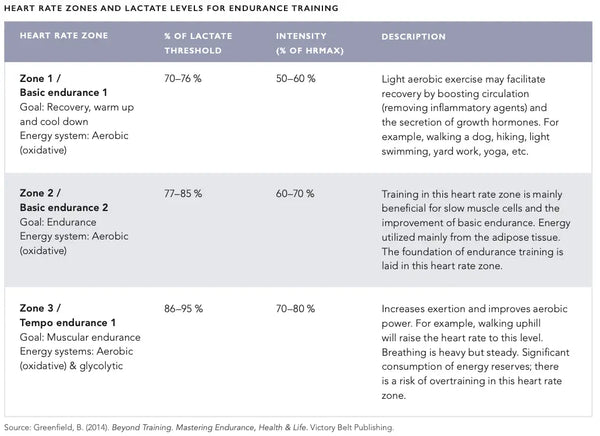
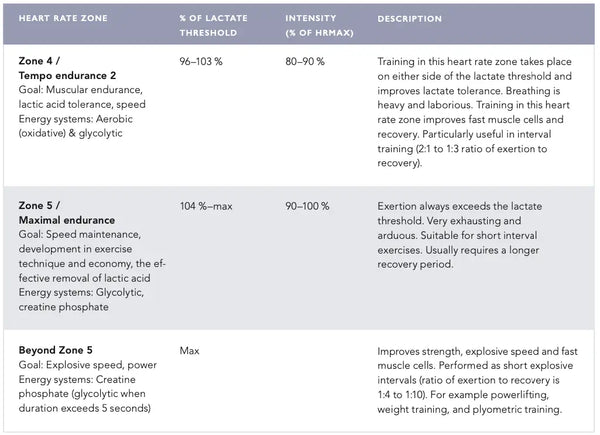
HOW TO UTILIZE HEART RATE ZONES IN TRAINING?
- If your endurance fitness level is good but you get fatigued as soon as your muscles start producing lactic acid, you should add intervals in heart rate zone 4
- If intervals pose no problem but you get fatigued during prolonged exercises performed at a steady pace, you should add exercises in heart rate zone 2 and intervals in zone 3
- If you can’t sprint to the finish at the end of a 5 kilometer run, you should add intervals in heart rate zone 5 (maximal endurance)
- If your body is slow to recover, add exercises in heart rate zone 1
Do 2-3x Zone 2 cardio weekly workouts for 30-60 minutes per workout (depending on your current fitness level; start low and build up). Zone 2 is a steady state low-intensity heart rate zone between 60-70% of maximum heart rate. It is low intensity enough to maintain nasal breathing and even talk. Zone 2 lays the foundation for cardiorespiratory fitness. Having a solid foundation with Zone 2 that builds slow twitch muscle fibers and increases the number of mitochondria improves one's overall cardiorespiratory fitness.
One should also do interval training one to two times per week.
The type of interval training can vary between how much time one has and how one feels. For example, 1-minute sprints at maximum effort followed by 1 minute rest and repeated for eight rounds. Another great option is 3–4-minute maximum sprints followed by 4 minutes of rest and repeated for four rounds.
Dr. Olli Sovijärvi's favorite interval or HIIT session is called the Gibala Mehthod, which is based on a 2010 study conducted on students, published by Martin Gibala, a doctor of physiology. The goal of the study was to determine the effect of high intensity (100 % VO2max) interval training on general performance using a method that is safer and of slightly lower intensity than the Tabata method.
The study continued for two weeks during which six stationary bike workouts were completed. Each workout included a 3-minute warm-up phase followed by the interval phase: 60 seconds of action followed by 75 seconds of rest, repeated 8–12 times. There was no control group involved in the study. Gibala found out that this method achieved the same oxygen uptake benefits as 5 hours of constant pace endurance training per week. The method also significantly increased the force generation capability of muscle cells and improved sugar metabolism.(12)
A 2019 meta-analysis of 53 studies found that short-intervals (≤30s), low-volume (≤5min), and short-term (≤ 4 weeks) are an effective and time-efficient ways to increase VO2 max. However, they found that to maximize VO2 max adaptations, long-interval (≥2min), high-volume (≥15min) and moderate to long-term (≥4-12weeks) are better.(13) So, more and longer intervals are generally superior to short and low-volume intervals. However, the short intervals are also effective if one lacks time.
- Training at the same intensity level and heart rate zone time after time
- Training at the same pace time after time
- Training too hard on lighter training days or vice versa
How to Measure Aerobic Fitness and Oxygen Uptake (VO2max)
Maximal oxygen uptake testing refers to the measurement of aerobic fitness through the concept of maximal oxygen uptake. Measuring and testing athletes began after the first official Olympic games, in 1886. The first bicycle ergometer was built in Denmark in 1910, marking an early tool used in exercise measurement. The concept of maximal oxygen uptake was developed in 1920 by physiologist Archibald Hill, 1886 to 1977.(14) Although measuring and testing athletes had earlier roots, comprehensive studies regarding maximal oxygen uptake testing were not published until the 1960s.(15-16) This timeline shows that maximal oxygen uptake testing developed over several decades, from early athlete measurement after 1886, to equipment development in 1910, to the oxygen uptake concept in 1920, and finally to broader scientific publication in the 1960s. In that historical sequence, maximal oxygen uptake testing emerged gradually rather than all at once.
OXYGEN UPTAKE
Oxygen uptake refers to the ability of the respiratory and circulatory system to transport oxygen and the ability of the muscles to use
it for energy production. Maximal oxygen uptake (VO2 max) refers to the oxygen uptake occurring under extreme stress. The terms oxygen uptake and oxygen consumption are often used interchangeably. Maximal oxygen uptake is expressed either as an absolute value (liters per minute) or more commonly as a relative value of liters per minute per kilogram of bodyweight (ml/kg/min). Oxygen uptake is indicative of endurance fitness which can be improved with regular endurance or interval training. The highest maximal oxygen uptake values have been measured for cyclists and skiers.(17)
UKK WALK TEST
The UKK walk test is a scientifically validated 2 kilometer walking test developed in Finland in the early 1990s to measure endurance fitness, meaning respiratory and circulatory system performance.(18)
It is intended especially for assessing the physical fitness of middle-aged people. It may also be applied to other age groups or overweight individuals.(19-20)
The test involves walking 2 kilometers on a level surface as fast as possible. A fitness index is calculated from walking time, heart rate at the end of the test, body mass index, and sex. The results are also used to estimate maximal oxygen uptake. Adequate accuracy is achieved when the end-test heart rate is at least 80 % of maximum heart rate.(21)
The test is not generally recommended for individuals with very high fitness levels, because it is not sufficiently strenuous in these cases.(22)
The UKK walk test formula for estimating maximal oxygen uptake: The result is VO2max (ml/min/kg)
184.9 , 4.65 x (time in minutes), 0.22 x (heartbeat), 0.26 x (age), 1.05 x (BMI)
116.2 , 2.98 x (time in minutes), 0.11 x (heartbeat), 0.14 x (age), 0.39 x (BMI)
Men:
Women:

CLINICAL EXERCISE STRESS TEST USING A BICYCLE
A clinical exercise stress test (exercise ECG) is usually conducted using a stationary bicycle (exercise ergometer) under the supervision of a doctor.
The test is offered by many medical clinics. Stress tests are also often conducted to study potential cardiovascular diseases. It is particularly common when diagnosing coronary heart disease. For the biohacker, a clinical exercise stress test using a bicycle is a good means of measuring aerobic fitness and anaerobic force generation, as long as the test is performed to absolute exhaustion.
Arterial blood oxygen level and lung function may also be measured during the test. Athletes usually undergo more comprehensive testing, i.e. running spiroergometry (see paragraph below). The doctor may interrupt the stress test if something unusual is detected in the symptoms, electrocardiogram, blood pressure, blood oxygen saturation, or other variables.(23)
The exercise stress test is usually initialized with low resistance (40 W for women, 50 W for men). The test is typically conducted with three-minute intervals between additions to resistance. For women, the increments in resistance are 40 W each, for men they are 50 W each. The pace is usually 60–70 rpm. Perceived exertion is assessed during the exercise stress test using the Borg scale. The objective of the exercise stress test is to achieve the perceived exertion rating of 90 % of maximum within 6–12 minutes by increasing the resistance level. For individuals of very high fitness, the time required may be significantly longer. Maximal oxygen uptake may be estimated based on the test results. However, for athletes, the accuracy is not sufficient when the performance is submaximal.(24-25)
-
Cycle Ergometer (YMCA) Protocol calculator (read instuctions in the link)
RUNNING SPIROERGOMETRY
Spiroergometry is the extended version of the clinical exercise stress test, intended especially for athletes. It is conducted using either a bicycle ergometer or treadmill. In addition to the analytical methods of the clinical exercise stress test, this test involves measuring respiratory gases and the tidal volume.The test allows for the direct measurement of oxygen consumption and carbon dioxide production and therefore the anaerobic threshold. The more comprehensive version can also involve measuring the lactic acid level in arterial blood.
The test subject pedals the bicycleergometer or runs on the treadmill, with incremental increases to resistance, either to submaximal or complete exhaustion. The respiratory gases are measured using a mask secured to the test subject's face.
Spiroergometry can accurately determine an individual's maximal oxygen consumption (oxygen uptake) and anaerobic threshold. This is the point where carbon dioxide production begins to increase compared to oxygen consumption and lactic acid begins to form in the blood. At the same time, the breathlessness level is significantly increased. Spiroergometry is the golden standard when it comes to studying performance-impairing factors related to respiration, the cardiovascular system, metabolism, etc. The spiroergometry test is also widely used to assess an individual’s ability to work.(26)


COOPER TEST
The Cooper test, developed by Dr. Kenneth H. Cooper in 1968 for the United States army, is used for the assessment of maximal endurance. It involves running as far as possible in 12 minutes. According to studies, a strong correlation exists between the Cooper test results and maximal oxygen uptake.(27) The test is best suited for runners as it utilizes running economy and technique.
Here is the Cooper test calculator for estimating your VO2max.
Wearable Tech for Testing VO2max
Wearable technology for VO2max estimation is a consumer method for estimating cardiovascular fitness outside clinical or laboratory testing.
Wearable devices, including fitness trackers and smartwatches, estimate VO2max with heart rate data, and sometimes age, gender, activity level and GPS data.(28) Wearable technology uses proprietary algorithms based on the relationship between heart rate and oxygen consumption. Accuracy can vary with sensor precision, individual variation and exercise conditions, such as steady-state or variable-intensity exercise.(28)
Compared with gold standard spiroergometry, wearable technology shows varying accuracy. Many devices give reasonably good estimates for general population use, especially at moderate fitness levels. Wearable technology may be less accurate for highly trained athletes or people with specific health conditions.(29) Wearable technology is best used to track changes over time and provide a general estimate of cardiovascular fitness.
For example, Garmin watches can estimate VO2 max during a run or brisk walk with heart rate and GPS tracking. Firstbeat Analytics examines pace and body effort.
Polar watches use a wrist-based Fitness Test at rest. The assessment takes 5 minutes and is developed for healthy adults.
Fitbit watches and bands can provide a Cardio Fitness Score that estimates VO2 max.
Waearbles that measure VO2max:
Calculators for testing VO2max
VO2 max calculator is a tool for sportspersons who want to find a maximal aerobic capacity value. VO2 max is a crucial parameter in endurance sports. VO2 max helps people train effectively and adequately. The article on the page gives brief information about what VO2 max is. The article also explains how to calculate VO2 max. Additionally, the article describes VO2 max tests and explains how to use the aerobic capacity calculator.
Testing methods that apply for the calculator:
- Resting heart rate (RHR)
- 1 mile walk test
- 3 minutes step test
- 1.5 mile walk/run test
- Best 2000m rowing time (indoor rower)
Conclusion
In summary, improving VO2max through endurance training is a primary intervention tactic for better general health and longer life. Studies further showed that the efficient control of respiratory system performance, circulatory system flows and muscle energy transformation processes played a pivotal role in this improvement. Cardiovascular fitness is only increased through essential aerobic exercises and intense maximal endurance workouts, constituents of endurance training. Knowledge and practice of heart rate zones in the training program provide a customized exercise method, which is more effective because it meets the current fitness level and needs.
Technological progress in evaluating VO2max, from classic tests such as spiroergometry to modern wearable devices, provides viable scientific information on cardiovascular well-being. Nevertheless, it is essential to realize that wearable gadgets are imperfect devices compared to clinical values and may only be beneficial in tracking trends. A consistent and comprehensive endurance training routine should be supported with the necessary insurance conditions off-field. In that case, it will increase cardiovascular performance, eliminating crucial risks associated with low cardiorespiratory fitness.
Scientific References
- Ghosh, A. (2004). Anaerobic threshold: its concept and role in endurance sport. The Malaysian Journal of Medical Sciences 11 (1): 24-36.
- Ivy, J. & Withers, R. & Van Handel, P. & Elger, D. & Costill, D. (1980). Muscle respiratory capacity and fiber type as determinants of the lactate threshold. Journal of Applied Physiology 48 (3): 523–527.
- Nes, B. & Janszky, I. & Wisløff, U. & Støylen, A. & Karlsen, T. (2013). Age-predicted maximal heart rate in healthy subjects: The HUNT fitness study. Scandinavian Journal of Medicine and Science in Sports 23 (6): 697–704.
- Kokkinos, P. et al. (2022). Cardiorespiratory fitness and mortality risk across the spectra of age, race, and sex. Journal of the American College of Cardiology 80 (6): 598-609.
- McArdle, W. & Katch, F. & Katch, V. (2014). Exercise Physiology. Nutrition, Energy and Human Performance. 8th Edition. Philadelphia: LWW.
- Iwasaki, K. & Zhang, R. & Zuckerman, J. & Levine, B. (2003). Dose-response relationship of the cardiovascular adaptation to endurance training in healthy adults: how much training for what benefit? Journal of Applied Physiology 95 (4): 1575–1583.
- Lee, I. & Hsieh, C. & Paffenbarger, R. Jr. (1995). Exercise intensity and longevity in men. The Harvard Alumni Health Study. JAMA (15): 1179–1184.
- Helgerud, J. et al. (2007). Aerobic high-intensity intervals improve VO2max more than moderate training. Medicine and Science in Sports and Exercise 39 (4): 665–671.
- Burgomaster, K. et al. (2008). Similar metabolic adaptations during exercise after low volume sprint interval and traditional endurance training in humans. Journal of Physiology 586 (1): 151–160.
- Rønnestad, B. & Mujika, I. (2014). Optimizing strength training for running and cycling endurance performance: A review. Scandinavian Journal of Medicine and Science in Sports 24 (4): 603–612.
- Little, J. & Safdar, A. & Wilkin, G. & Tarnopolsky, M. & Gibala, M. (2009). A practical model of low-volume high-intensity interval training induces mitochondrial biogenesis in human skeletal muscle: potential mechanisms. Journal of Physiology 588 (Pt 6): 1011–1022.
- Wen, D. et al. (2019). Effects of different protocols of high intensity interval training for VO2max improvements in adults: A meta-analysis of randomised controlled trials. Journal of SciencM and medicine in Sport 22 (8): 941-947.
- Seiler, S. (2011). A brief history of endurance testing in athletes. Sportscience 15: 40–86.
- Taylor, H. & Buskirk, E. & Henschel, A. (1955). Maximal oxygen intake as an objective measure of cardio-respiratory performance. Journal of Applied Physiology 8 (1): 73–80.
- Åstrand, P & Saltin, B. (1961). Maximal oxygen uptake and heart rate in various types of muscular activity. Journal of Applied Physiology 16: 977–981.
- Bassett, D. & Howley, E. (2000). Limiting factors for maximum oxygen uptake and determinants of endurance performance. Medicine and Science in Sports and Exercise 32 (1): 70-84.
- Rance, M. et al. (2005). Validity of a VO2 max prediction equation of the 2-km walk test in female seniors. International Journal of Sports Medicine 26 (6): 453–456.
- Oja, P. & Laukkanen, R. & Pasanen, M. & Tyry, T. & Vuori, I. (1991). A 2-km walking test for assessing the cardiorespiratory fitness of healthy adults. International Journal of Sports Medicine 12 (4): 356–362.
- Laukkanen, R. & Oja, P. & Pasanen, M. & Vuori, I. (1992). Validity of a two kilometre walking test for estimating maximal aerobic power in overweight adults. International Journal of Obesity Related Metabolic Disorders 16 (4): 263–268.
- Laukkanen, R. & Oja, P. & Pasanen, M. &. Vuori, I. (1993). A two-kilometer walking test: effect of walking speed on the prediction of maximal oxygen uptake. Scandinavian Journal of Medicine and Science in Sports 3 (4): 263–266.
- Laukkanen, R. & Oja, P. & Pasanen, M. &. Vuori, I. (1993). Criterion validity of a two-kilometer walking test for predicting the maximal oxygen uptake of moderately to highly active middle-aged adults. Scandinavian Journal of Medicine and Science in Sports 3 (4): 267–272.
- Fletcher, G. et al. (2013). American Heart Association Exercise, Cardiac Rehabilitation, and Prevention Committee of the Council on Clinical Cardiology, Council on Nutrition, Physical Activity and Metabolism, Council on Cardiovascular and Stroke Nursing, and Council on Epidemiology and Prevention. Exercise standards for testing and training: a scientific statement from the American Heart Association. Circulation 128 (8): 873–934.
- Smith, A. & Evans, H. & Parfitt. G. & Eston, R. & Ferrar, K. (2016). Submaximal Exercise-Based Equations to Predict Maximal Oxygen Uptake in Older Adults: A Systematic Review. Archives of Physical Medicine and Rehabilitation 97 (6): 1003–1012.
- Evans, H. & Ferrar, K. & Smith, A. & Parfitt, G. & Eston, R. (2015). A systematic review of methods to predict maximal oxygen uptake from submaximal, open circuit spirometry in healthy adults. Journal of Science in Medicine and Sport 18 (2): 183–188.
- Piirilä, P. & Sovijärvi, A. (2013). Spiroergometry in the assessment of exercise capacity and associated restrictive factors. Duodecim; Laaketieteellinen Aikakauskirja 129 (12):1251-1261.
- Grant, S. & Corbett, K. & Amjad, A. & Wilson, J. & Aitchison, T. (1995). A comparison of methods of predicting maximum oxygen uptake. British Journal of Sports Medicine 29 (3): 147–152.
- Neshitov, A. et al. (2023). Estimation of cardiorespiratory fitness using heart rate and step count data. Scientific Reports 13 (1): 15808.
- Shei, R. & Holder, I. & Oumsang, A. & Paris, B. & Paris, H. (2022). Wearable activity trackers–advanced technology or advanced marketing? European Journal of Applied Physiology 122 (9): 1975-1990.
