

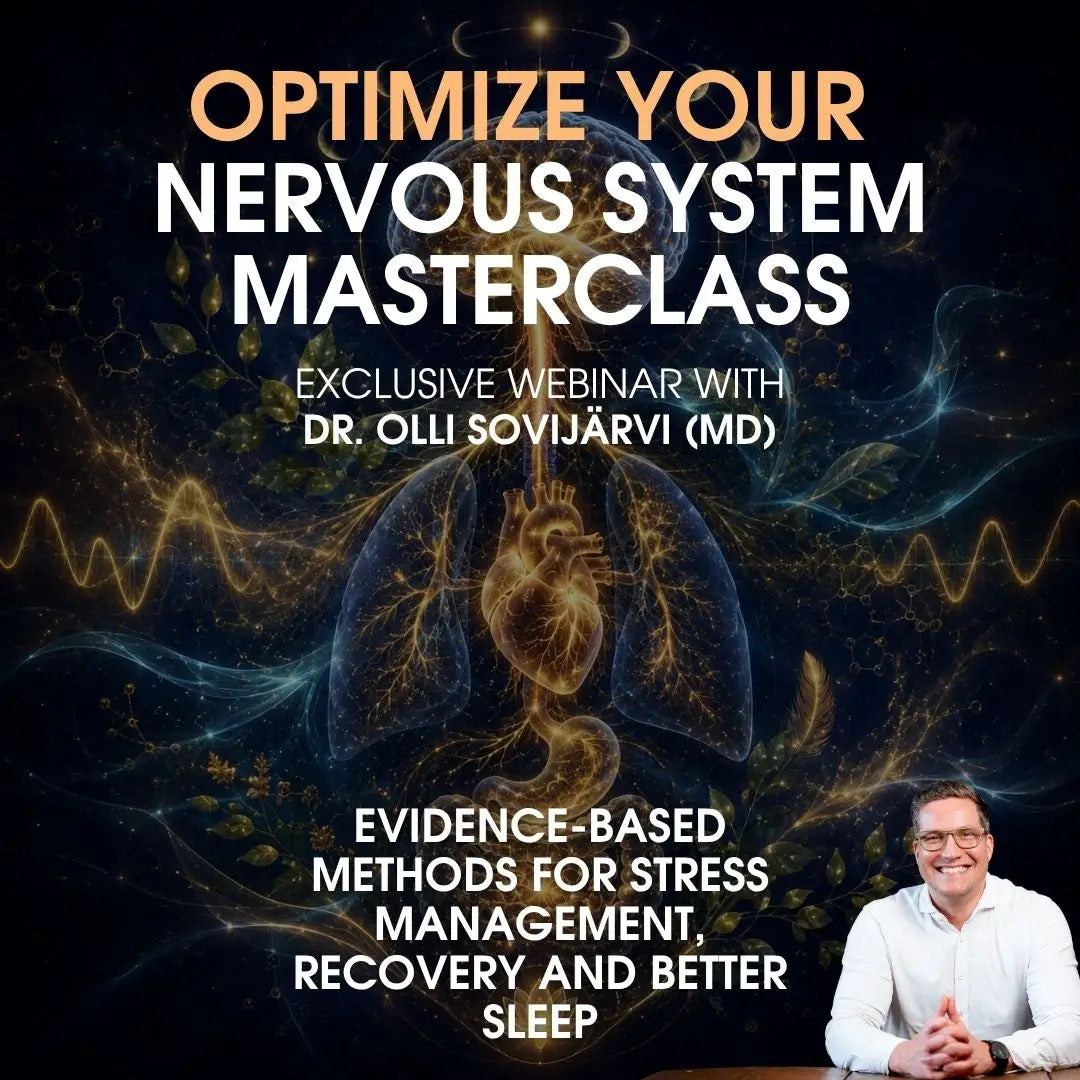
Stress is not the enemy – poor regulation is the problem
The stress response helps you act, focus, and adapt. However, ongoing strain, insufficient recovery, and methods that do not match the situation can maintain hyperarousal, disrupt sleep, impair concentration, and increase feelings of exhaustion.
Many people try to solve the problem by adding more relaxation exercises or tracking a single HRV value. This is not always enough. The same exercise does not suit everyone, and the same nervous system state does not always require calming. Sometimes the body needs recovery. Sometimes it needs movement, light, rhythm, or appropriate activation.
After this webinar, you will know how to ask the right question: what does my nervous system need right now?
What will the webinar cover?
1. The foundations of nervous system function
- How do the sympathetic and parasympathetic nervous systems regulate arousal, performance, and recovery?
- What happens during the stress response over seconds, minutes, and hours?
- What do allostasis and allostatic load mean in practice?
- Why is the goal not the strongest possible parasympathetic state, but flexible regulation?
2. The vagus nerve without the mystique
- What is the vagus nerve, and how does it carry information between the brain and the body?
- How is the vagus nerve involved in the regulation of the heart, breathing, digestion, inflammation, and the stress response?
- What does “vagus nerve activation” mean physiologically?
- Which common claims about the vagus nerve are supported by research, and which go too far?
3. Identify your nervous system state
- How can hyperarousal, insufficient recovery, and low arousal show up in the body and mind?
- How can you distinguish a temporary stress response from longer-lasting strain?
- What can sleep, resting heart rate, breathing rate, mood, performance, and perceived recovery tell you?
- When do symptoms require evaluation by a healthcare professional?
4. HRV and other recovery metrics
- What does heart rate variability, or HRV, measure, and what does it not measure?
- How can you interpret data from the Oura Ring and other wearables sensibly?
- Why are your personal baseline and long-term trend more important than comparison with others?
- How can you establish a seven-day baseline without turning measurement into another source of stress?
5. Fast-acting regulation tools
- Slow breathing, resonance breathing, and HRV biofeedback
- The physiological sigh and exhalation-focused techniques
- Diaphragmatic breathing, nasal breathing, and the role of carbon dioxide tolerance
- Mindfulness, meditation, progressive muscle relaxation, and body-based methods
- Movement, nature, and social connection as support for nervous system regulation
- A clear 10-minute recovery exercise that you can start using immediately
6. Lifestyle factors that build nervous system capacity
- Sleep, circadian rhythm, and morning light
- Endurance exercise, strength training, and appropriate training load
- Post-exercise parasympathetic recovery
- Sauna and cold exposure: when do they support adaptation, and when do they add to your load?
- Blood glucose variability, energy intake, hydration, and nervous system function
- The effects of caffeine, alcohol, and nicotine on arousal, sleep, and HRV
7. Supplements to support the nervous system and stress regulation
- Magnesium, omega-3 fatty acids, and L-theanine
- Adaptogens and what the research actually shows
- Who may benefit from supplements, and when can they involve risks or interactions?
- Why can no supplement compensate for inadequate sleep, excessive load, or a persistent energy deficit?
8. Vagus nerve stimulation and recovery technology
- How does non-invasive vagus nerve stimulation applied to the ear or neck work?
- What does research show about the effects of taVNS on stress, sleep, and autonomic regulation?
- How do vagus nerve stimulation devices differ from indirect relaxation and vibration technologies?
- When can a device complement the fundamentals, and when is it unlikely to provide meaningful benefit?
- Safety, use cases, and the most important contraindications
9. Your personal nervous system protocol
- Which method is suitable for acute stress, a recovery break during the workday, after exercise, and before sleep?
- How can you build a practical regulation routine for morning, daytime, and evening?
- How can you track your response and adjust your protocol based on your own data and how you feel?
- A 14-day program that helps you put the information into practice one step at a time
Why should you join this webinar?
- Get the big picture. Understand how stress, breathing, sleep, exercise, nutrition, the mind, and the vagus nerve relate to one another.
- Learn to prioritize. Know which methods form the foundation and which are complementary.
- Avoid common mistakes. Do not try to raise HRV at any cost or calm your nervous system when it actually needs activation.
- Get practical tools. Learn short exercises and longer-term strategies for different situations.
- Understand your measurement data. Learn how to use HRV and other metrics to support decision-making without overanalyzing a single number.
- See the limits of the evidence. Get a clear assessment of the evidence for breathing exercises, vagus nerve stimulation, cold exposure, sauna, supplements, and recovery devices.
- Leave with a plan. Get a ready-made framework for building your own 14-day nervous system program.
Who is this webinar for?
This webinar is for you if you:
- experience constant urgency, hyperarousal, or difficulty calming down
- struggle to recover after the workday, exercise, or other forms of strain
- want to improve the conditions that support better sleep, focus, and energy
- track HRV, resting heart rate, or sleep but are not always sure how to interpret the data
- are interested in the vagus nerve, breathing exercises, or non-invasive neuromodulation
- want to reduce guesswork and build an evidence-based recovery routine
- work in health, wellness, coaching, or performance and want to deepen your expertise
You do not need prior knowledge of the autonomic nervous system. The webinar progresses clearly from the fundamentals to practical applications.
Your expert: physician Olli Sovijärvi
The webinar is led by physician, author, and Hololife Center medical expert Olli Sovijärvi. His areas of expertise include preventive health, stress physiology, recovery, performance measurement, and lifestyle medicine.
Sovijärvi has written books including Biohakkerin käsikirja, Biohakkerin stressikirja, and The Resilient Being. His approach combines medical physiology, current research literature, practical protocols, and measurable self-tracking.
You will get a clear model for a complex topic: what to do, when to do it, and how to assess whether a method works for you.

What do you get when you join?
- a comprehensive expert webinar on nervous system regulation
- a practical 10-minute recovery exercise
- a framework for tracking your nervous system state and recovery
- a 14-day nervous system program
- a clear summary of the strength of evidence for different methods
- a downloadable slide deck or summary
- a recording of the webinar
- a live Q&A session
Frequently asked questions
Do I need a vagus nerve stimulation device?
No. The foundation of the webinar consists of breathing, sleep, movement, circadian rhythm, load management, and other methods that do not require devices. Technology is covered as a complementary option.
Is the webinar suitable for beginners?
Yes. The webinar starts with the fundamentals of nervous system function. At the same time, the content provides deeper information for health and wellness professionals.
Will I get practical exercises from the webinar?
Yes. You will learn several methods for different situations and complete a guided recovery exercise. You will also get a framework for the 14-day program.
Does the webinar cover HRV and Oura data?
Yes. You will learn what HRV tells you about autonomic regulation, which factors can change the reading, and why your own trend matters more than a single result.
Does the webinar cover vagus nerve stimulation devices?
Yes. The webinar covers how non-invasive vagus nerve stimulation works, the current research evidence, differences between devices, use cases, and safety. The goal is not to present any single device as a universal solution.
Does the webinar replace an evaluation by a physician or another healthcare professional?
No. The webinar provides general information and tools to support well-being. It does not diagnose or treat disease. Persistent or severe symptoms, fainting, chest pain, arrhythmias, severe insomnia, significant mood symptoms, or a decline in functional capacity require professional evaluation.
Do not leave your recovery to guesswork
Nervous system regulation is a skill. When you understand your current state and choose a method that matches it, you can support recovery with small but repeated actions. You do not need ten new routines. You need a system that works, enough tracking to guide your choices, and methods you can use even on a busy day.
Join the webinar and build your own evidence-based nervous system protocol.
When you order, you will receive:
- Confirmation of your registration by email
- A calendar link that allows you to join the webinar at the scheduled date and time
- Access to the live webinar on your mobile device, tablet, or computer
- A full recording of the webinar to watch later (also a good option if you only want the recording)
The webinar content is intended for general information and to support personal well-being. It does not replace an individualized medical assessment, diagnosis, or treatment. Discuss significant changes with your physician, especially if you have cardiovascular disease, an arrhythmia, epilepsy, an implanted electronic medical device, are pregnant, have a psychiatric condition, have a significant autonomic nervous system disorder, or take medication that could be affected by such changes.
Stress is not the enemy – poor regulation is the problem
The stress response helps you act, focus, and adapt. However, ongoing strain, insufficient recovery, and methods that do not match the situation can maintain hyperarousal, disrupt sleep, impair concentration, and increase feelings of exhaustion.
Many people try to solve the problem by adding more relaxation exercises or tracking a single HRV value. This is not always enough. The same exercise does not suit everyone, and the same nervous system state does not always require calming. Sometimes the body needs recovery. Sometimes it needs movement, light, rhythm, or appropriate activation.
After this webinar, you will know how to ask the right question: what does my nervous system need right now?
What will the webinar cover?
1. The foundations of nervous system function
- How do the sympathetic and parasympathetic nervous systems regulate arousal, performance, and recovery?
- What happens during the stress response over seconds, minutes, and hours?
- What do allostasis and allostatic load mean in practice?
- Why is the goal not the strongest possible parasympathetic state, but flexible regulation?
2. The vagus nerve without the mystique
- What is the vagus nerve, and how does it carry information between the brain and the body?
- How is the vagus nerve involved in the regulation of the heart, breathing, digestion, inflammation, and the stress response?
- What does “vagus nerve activation” mean physiologically?
- Which common claims about the vagus nerve are supported by research, and which go too far?
3. Identify your nervous system state
- How can hyperarousal, insufficient recovery, and low arousal show up in the body and mind?
- How can you distinguish a temporary stress response from longer-lasting strain?
- What can sleep, resting heart rate, breathing rate, mood, performance, and perceived recovery tell you?
- When do symptoms require evaluation by a healthcare professional?
4. HRV and other recovery metrics
- What does heart rate variability, or HRV, measure, and what does it not measure?
- How can you interpret data from the Oura Ring and other wearables sensibly?
- Why are your personal baseline and long-term trend more important than comparison with others?
- How can you establish a seven-day baseline without turning measurement into another source of stress?
5. Fast-acting regulation tools
- Slow breathing, resonance breathing, and HRV biofeedback
- The physiological sigh and exhalation-focused techniques
- Diaphragmatic breathing, nasal breathing, and the role of carbon dioxide tolerance
- Mindfulness, meditation, progressive muscle relaxation, and body-based methods
- Movement, nature, and social connection as support for nervous system regulation
- A clear 10-minute recovery exercise that you can start using immediately
6. Lifestyle factors that build nervous system capacity
- Sleep, circadian rhythm, and morning light
- Endurance exercise, strength training, and appropriate training load
- Post-exercise parasympathetic recovery
- Sauna and cold exposure: when do they support adaptation, and when do they add to your load?
- Blood glucose variability, energy intake, hydration, and nervous system function
- The effects of caffeine, alcohol, and nicotine on arousal, sleep, and HRV
7. Supplements to support the nervous system and stress regulation
- Magnesium, omega-3 fatty acids, and L-theanine
- Adaptogens and what the research actually shows
- Who may benefit from supplements, and when can they involve risks or interactions?
- Why can no supplement compensate for inadequate sleep, excessive load, or a persistent energy deficit?
8. Vagus nerve stimulation and recovery technology
- How does non-invasive vagus nerve stimulation applied to the ear or neck work?
- What does research show about the effects of taVNS on stress, sleep, and autonomic regulation?
- How do vagus nerve stimulation devices differ from indirect relaxation and vibration technologies?
- When can a device complement the fundamentals, and when is it unlikely to provide meaningful benefit?
- Safety, use cases, and the most important contraindications
9. Your personal nervous system protocol
- Which method is suitable for acute stress, a recovery break during the workday, after exercise, and before sleep?
- How can you build a practical regulation routine for morning, daytime, and evening?
- How can you track your response and adjust your protocol based on your own data and how you feel?
- A 14-day program that helps you put the information into practice one step at a time
Why should you join this webinar?
- Get the big picture. Understand how stress, breathing, sleep, exercise, nutrition, the mind, and the vagus nerve relate to one another.
- Learn to prioritize. Know which methods form the foundation and which are complementary.
- Avoid common mistakes. Do not try to raise HRV at any cost or calm your nervous system when it actually needs activation.
- Get practical tools. Learn short exercises and longer-term strategies for different situations.
- Understand your measurement data. Learn how to use HRV and other metrics to support decision-making without overanalyzing a single number.
- See the limits of the evidence. Get a clear assessment of the evidence for breathing exercises, vagus nerve stimulation, cold exposure, sauna, supplements, and recovery devices.
- Leave with a plan. Get a ready-made framework for building your own 14-day nervous system program.
Who is this webinar for?
This webinar is for you if you:
- experience constant urgency, hyperarousal, or difficulty calming down
- struggle to recover after the workday, exercise, or other forms of strain
- want to improve the conditions that support better sleep, focus, and energy
- track HRV, resting heart rate, or sleep but are not always sure how to interpret the data
- are interested in the vagus nerve, breathing exercises, or non-invasive neuromodulation
- want to reduce guesswork and build an evidence-based recovery routine
- work in health, wellness, coaching, or performance and want to deepen your expertise
You do not need prior knowledge of the autonomic nervous system. The webinar progresses clearly from the fundamentals to practical applications.
Your expert: physician Olli Sovijärvi
The webinar is led by physician, author, and Hololife Center medical expert Olli Sovijärvi. His areas of expertise include preventive health, stress physiology, recovery, performance measurement, and lifestyle medicine.
Sovijärvi has written books including Biohakkerin käsikirja, Biohakkerin stressikirja, and The Resilient Being. His approach combines medical physiology, current research literature, practical protocols, and measurable self-tracking.
You will get a clear model for a complex topic: what to do, when to do it, and how to assess whether a method works for you.
What do you get when you join?
- a comprehensive expert webinar on nervous system regulation
- a practical 10-minute recovery exercise
- a framework for tracking your nervous system state and recovery
- a 14-day nervous system program
- a clear summary of the strength of evidence for different methods
- a downloadable slide deck or summary
- a recording of the webinar
- a live Q&A session
Frequently asked questions
Do I need a vagus nerve stimulation device?
No. The foundation of the webinar consists of breathing, sleep, movement, circadian rhythm, load management, and other methods that do not require devices. Technology is covered as a complementary option.
Is the webinar suitable for beginners?
Yes. The webinar starts with the fundamentals of nervous system function. At the same time, the content provides deeper information for health and wellness professionals.
Will I get practical exercises from the webinar?
Yes. You will learn several methods for different situations and complete a guided recovery exercise. You will also get a framework for the 14-day program.
Does the webinar cover HRV and Oura data?
Yes. You will learn what HRV tells you about autonomic regulation, which factors can change the reading, and why your own trend matters more than a single result.
Does the webinar cover vagus nerve stimulation devices?
Yes. The webinar covers how non-invasive vagus nerve stimulation works, the current research evidence, differences between devices, use cases, and safety. The goal is not to present any single device as a universal solution.
Does the webinar replace an evaluation by a physician or another healthcare professional?
No. The webinar provides general information and tools to support well-being. It does not diagnose or treat disease. Persistent or severe symptoms, fainting, chest pain, arrhythmias, severe insomnia, significant mood symptoms, or a decline in functional capacity require professional evaluation.
Do not leave your recovery to guesswork
Nervous system regulation is a skill. When you understand your current state and choose a method that matches it, you can support recovery with small but repeated actions. You do not need ten new routines. You need a system that works, enough tracking to guide your choices, and methods you can use even on a busy day.
Join the webinar and build your own evidence-based nervous system protocol.
When you order, you will receive:
- Confirmation of your registration by email
- A calendar link that allows you to join the webinar at the scheduled date and time
- Access to the live webinar on your mobile device, tablet, or computer
- A full recording of the webinar to watch later (also a good option if you only want the recording)
The webinar content is intended for general information and to support personal well-being. It does not replace an individualized medical assessment, diagnosis, or treatment. Discuss significant changes with your physician, especially if you have cardiovascular disease, an arrhythmia, epilepsy, an implanted electronic medical device, are pregnant, have a psychiatric condition, have a significant autonomic nervous system disorder, or take medication that could be affected by such changes.
- (Die Mehrwertsteuer wird an der Kasse hinzugefügt, wenn die Versand- und Rechnungsadresse bekannt ist)
- Weltweite Lieferung (mit Sendungsverfolgung)
- Aus der EU versandt
- Top-bewerteter Verkäufer
Führendes Unternehmen für die Optimierung der Gesundheitsspanne, das sich darauf konzentriert, Ihnen die weltweit besten Inhalte, Nahrungsergänzungsmittel, Technologien, Kurse und Veranstaltungen zu bieten, damit Sie nicht mehr raten müssen, wie Sie sich für gesunde Gewohnheiten einsetzen, Ihre Gesundheitsspanne verlängern und ein produktives Leben führen können.
Folgen Sie uns auf den sozialen Medien:
