


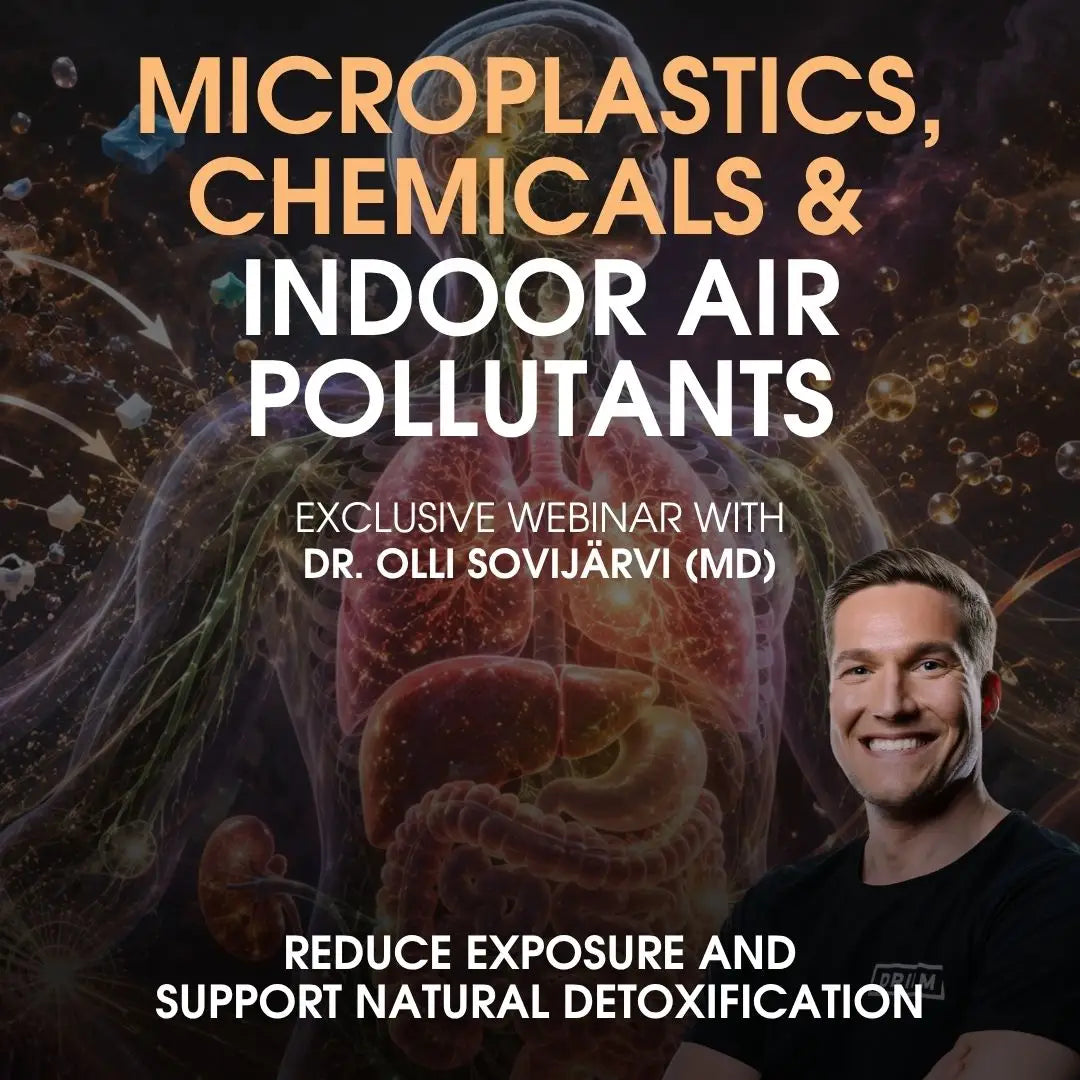
Do you know how much your daily environment affects your health? Many invisible exposures come from ordinary sources: indoor air, household dust, plastic packaging, drinking water, detergents, cosmetics, textiles, cooking, fragrances, and building materials.
Microplastics do not decrease simply by changing your water bottle. Chemical load does not decrease simply by using natural cosmetics. Indoor air does not improve through occasional ventilation alone.
🏠 A healthier everyday environment is built through the right order: first identify the largest sources of exposure, then improve indoor air, materials, drinking water, food quality, skin contact, and the body’s own protective mechanisms.
In this webinar, you will learn a practical model for clearly, safely, and without unnecessary complexity reducing invisible everyday exposure. You will get a concrete plan that helps you improve your home, indoor air, kitchen, drinking water, cosmetics, textiles, and recovery environment one step at a time.
Who is this designed for
- For those concerned about microplastics: learn where microplastics can come from and how exposure can be reduced in daily life.
- For those who want to reduce chemical load: understand how cosmetics, detergents, fragrances, coatings, plastics, PFAS compounds, phthalates, bisphenols, and pesticide residues affect the total burden.
- For those who want better indoor air: learn how CO₂, humidity, fine particles, VOC compounds, dust, mold, ventilation, cooking emissions, and fragrances affect the breathing environment.
- For health-conscious families: get a practical model for making the home, kitchen, bedroom, and daily routines healthier.
- For people who react to fragrances, dust, or cleaning products: learn how to reduce irritating compounds and build a simpler, safer home routine.
- For biohackers and preventive health enthusiasts: learn how measurement, tracking, nutrition, and environmental optimization fit into a coherent whole.
- For health professionals: get a clear framework for understanding everyday environmental exposure and practical reduction strategies.
Why you should participate
- You get a clear overall picture: understand how microplastics, chemicals, indoor air, drinking water, dust, cosmetics, and materials affect everyday exposure.
- You learn the right order of action: know what to change first, what to measure, and what can wait.
- You avoid unnecessary purchases: learn what truly matters and what is often secondary or mainly marketing.
- You get practical home strategies: improve your kitchen, bedroom, indoor air, cleaning routines, drinking water, and skin care step by step.
- You support the body’s natural defense systems: understand how nutrition, gut function, sweating, sleep, and recovery support normal detoxification and resilience.
- You get the recording: watch the webinar later and return to the content at your own pace.
- You get a concrete action model: start applying the lessons immediately after the webinar.
What you will learn in the webinar
1) The most important risks in environmental health
Learn what environmental health means in practice and how microplastics, chemicals, indoor air pollutants, dust, cooking emissions, materials, and everyday products can increase the body’s total burden.
2) Where microplastics and nanoplastics come from
Learn how bottled water, plastic packaging, heating food in plastic, synthetic textiles, household dust, cosmetics, food storage, and indoor air can contribute to daily microplastic exposure.
3) How to reduce household chemical load
Learn to identify common chemical exposure sources, including fragrances, plastics, coatings, detergents, skin care products, PFAS compounds, phthalates, bisphenols, flame retardants, and pesticide residues.
4) How to improve indoor air in practice
Learn how ventilation, humidity, carbon dioxide, fine particles, VOC compounds, dust, cooking, candles, fragrances, fireplaces, and possible moisture damage affect indoor air quality.
5) How to make your kitchen healthier
Learn how food storage, heating, frying pans, cutting boards, dishes, packaging materials, and drinking water affect total everyday exposure.
6) How to assess drinking water quality and filtration
Learn when water filtration can be useful, how bottled water can increase microplastic exposure, and what you should find out about your drinking water quality.
7) How to optimize the bedroom and recovery environment
Learn why the bedroom is one of the most important spaces for environmental health. Dust, textiles, ventilation, temperature, humidity, mattresses, bed linen, and fragrances can all affect the total burden.
8) How nutrition supports the body’s protective mechanisms
Learn how nutrients, amino acids, vitamins, minerals, antioxidants, fiber, polyphenols, and sulfur compounds support normal cellular protection, liver function, gut function, and elimination pathways.
9) How to use supplements and supportive methods with consideration
Learn which nutrients and supportive methods can support the body’s normal antioxidant protection, gut function, liver function, and recovery. The webinar also explains why reducing exposure and strengthening the foundation should come first.
10) How to measure and track what works
Learn how to track indoor air, humidity, CO₂ level, fine particles, VOC estimates, radon, water quality, symptoms, sleep, recovery, and everyday exposure changes.
Webinar host
DR. OLLI SOVIJÄRVI
Dr. Olli Sovijärvi is one of the pioneers of international holistic medicine, the Medical Director of Hololife Center, and the lead author of the Biohacker’s Handbook series. He has worked at nearly 50 different clinics and emergency units and has served as a consultant for various companies and service providers in the wellness and health technology sectors.
He has practiced medicine and specialized in nutrition, gut balance, and holistic health care. He currently practices preventive health care and health optimization. Sovijärvi has researched and tested practical solutions for holistic health, nutrition, environmental health, indoor air, recovery, measurement, and biohacking for more than 15 years.
In this webinar, he brings together the key risks in environmental health and practical reduction methods into a clear, everyday-friendly whole.

You will get:
- Access to the live webinar
- The full webinar recording to watch later
- A practical 2–3 week plan for reducing everyday exposure
- A clear model for improving your home, indoor air, kitchen, drinking water, cosmetics, textiles, and recovery environment
- Practical tools for supporting the body’s natural detoxification and protective mechanisms
The webinar content is intended as general information and as support for your own well-being. It does not replace personal medical evaluation, diagnosis, treatment, investigation by an indoor air specialist, building health investigation, or official guidelines.
Always discuss significant changes with your own physician or another qualified professional, especially if you have an illness, medication, pregnancy, breastfeeding, indoor air symptoms, severe allergies, chemical sensitivity, or another specific health situation.
Do you know how much your daily environment affects your health? Many invisible exposures come from ordinary sources: indoor air, household dust, plastic packaging, drinking water, detergents, cosmetics, textiles, cooking, fragrances, and building materials.
Microplastics do not decrease simply by changing your water bottle. Chemical load does not decrease simply by using natural cosmetics. Indoor air does not improve through occasional ventilation alone.
🏠 A healthier everyday environment is built through the right order: first identify the largest sources of exposure, then improve indoor air, materials, drinking water, food quality, skin contact, and the body’s own protective mechanisms.
In this webinar, you will learn a practical model for clearly, safely, and without unnecessary complexity reducing invisible everyday exposure. You will get a concrete plan that helps you improve your home, indoor air, kitchen, drinking water, cosmetics, textiles, and recovery environment one step at a time.
Who is this designed for
- For those concerned about microplastics: learn where microplastics can come from and how exposure can be reduced in daily life.
- For those who want to reduce chemical load: understand how cosmetics, detergents, fragrances, coatings, plastics, PFAS compounds, phthalates, bisphenols, and pesticide residues affect the total burden.
- For those who want better indoor air: learn how CO₂, humidity, fine particles, VOC compounds, dust, mold, ventilation, cooking emissions, and fragrances affect the breathing environment.
- For health-conscious families: get a practical model for making the home, kitchen, bedroom, and daily routines healthier.
- For people who react to fragrances, dust, or cleaning products: learn how to reduce irritating compounds and build a simpler, safer home routine.
- For biohackers and preventive health enthusiasts: learn how measurement, tracking, nutrition, and environmental optimization fit into a coherent whole.
- For health professionals: get a clear framework for understanding everyday environmental exposure and practical reduction strategies.
Why you should participate
- You get a clear overall picture: understand how microplastics, chemicals, indoor air, drinking water, dust, cosmetics, and materials affect everyday exposure.
- You learn the right order of action: know what to change first, what to measure, and what can wait.
- You avoid unnecessary purchases: learn what truly matters and what is often secondary or mainly marketing.
- You get practical home strategies: improve your kitchen, bedroom, indoor air, cleaning routines, drinking water, and skin care step by step.
- You support the body’s natural defense systems: understand how nutrition, gut function, sweating, sleep, and recovery support normal detoxification and resilience.
- You get the recording: watch the webinar later and return to the content at your own pace.
- You get a concrete action model: start applying the lessons immediately after the webinar.
What you will learn in the webinar
1) The most important risks in environmental health
Learn what environmental health means in practice and how microplastics, chemicals, indoor air pollutants, dust, cooking emissions, materials, and everyday products can increase the body’s total burden.
2) Where microplastics and nanoplastics come from
Learn how bottled water, plastic packaging, heating food in plastic, synthetic textiles, household dust, cosmetics, food storage, and indoor air can contribute to daily microplastic exposure.
3) How to reduce household chemical load
Learn to identify common chemical exposure sources, including fragrances, plastics, coatings, detergents, skin care products, PFAS compounds, phthalates, bisphenols, flame retardants, and pesticide residues.
4) How to improve indoor air in practice
Learn how ventilation, humidity, carbon dioxide, fine particles, VOC compounds, dust, cooking, candles, fragrances, fireplaces, and possible moisture damage affect indoor air quality.
5) How to make your kitchen healthier
Learn how food storage, heating, frying pans, cutting boards, dishes, packaging materials, and drinking water affect total everyday exposure.
6) How to assess drinking water quality and filtration
Learn when water filtration can be useful, how bottled water can increase microplastic exposure, and what you should find out about your drinking water quality.
7) How to optimize the bedroom and recovery environment
Learn why the bedroom is one of the most important spaces for environmental health. Dust, textiles, ventilation, temperature, humidity, mattresses, bed linen, and fragrances can all affect the total burden.
8) How nutrition supports the body’s protective mechanisms
Learn how nutrients, amino acids, vitamins, minerals, antioxidants, fiber, polyphenols, and sulfur compounds support normal cellular protection, liver function, gut function, and elimination pathways.
9) How to use supplements and supportive methods with consideration
Learn which nutrients and supportive methods can support the body’s normal antioxidant protection, gut function, liver function, and recovery. The webinar also explains why reducing exposure and strengthening the foundation should come first.
10) How to measure and track what works
Learn how to track indoor air, humidity, CO₂ level, fine particles, VOC estimates, radon, water quality, symptoms, sleep, recovery, and everyday exposure changes.
Webinar host
DR. OLLI SOVIJÄRVI
Dr. Olli Sovijärvi is one of the pioneers of international holistic medicine, the Medical Director of Hololife Center, and the lead author of the Biohacker’s Handbook series. He has worked at nearly 50 different clinics and emergency units and has served as a consultant for various companies and service providers in the wellness and health technology sectors.
He has practiced medicine and specialized in nutrition, gut balance, and holistic health care. He currently practices preventive health care and health optimization. Sovijärvi has researched and tested practical solutions for holistic health, nutrition, environmental health, indoor air, recovery, measurement, and biohacking for more than 15 years.
In this webinar, he brings together the key risks in environmental health and practical reduction methods into a clear, everyday-friendly whole.
You will get:
- Access to the live webinar
- The full webinar recording to watch later
- A practical 2–3 week plan for reducing everyday exposure
- A clear model for improving your home, indoor air, kitchen, drinking water, cosmetics, textiles, and recovery environment
- Practical tools for supporting the body’s natural detoxification and protective mechanisms
The webinar content is intended as general information and as support for your own well-being. It does not replace personal medical evaluation, diagnosis, treatment, investigation by an indoor air specialist, building health investigation, or official guidelines.
Always discuss significant changes with your own physician or another qualified professional, especially if you have an illness, medication, pregnancy, breastfeeding, indoor air symptoms, severe allergies, chemical sensitivity, or another specific health situation.
- (DPH bude připočtena při objednávce, jakmile bude známa dodací a fakturační adresa)
- Celosvětové doručení (možnost sledování)
- Odesláno z EU
- Nejlépe hodnocený prodejce
Přední společnost zaměřená na optimalizaci zdravotního rozpětí, která vám přináší nejlepší obsah, doplňky stravy, technologie, kurzy a události na světě, abyste se mohli zbavit dohadů o tom, jak prosazovat zdravé návyky, prodloužit své zdravotní rozpětí a vést produktivní život.
Sledujte nás na sociálních sítích: